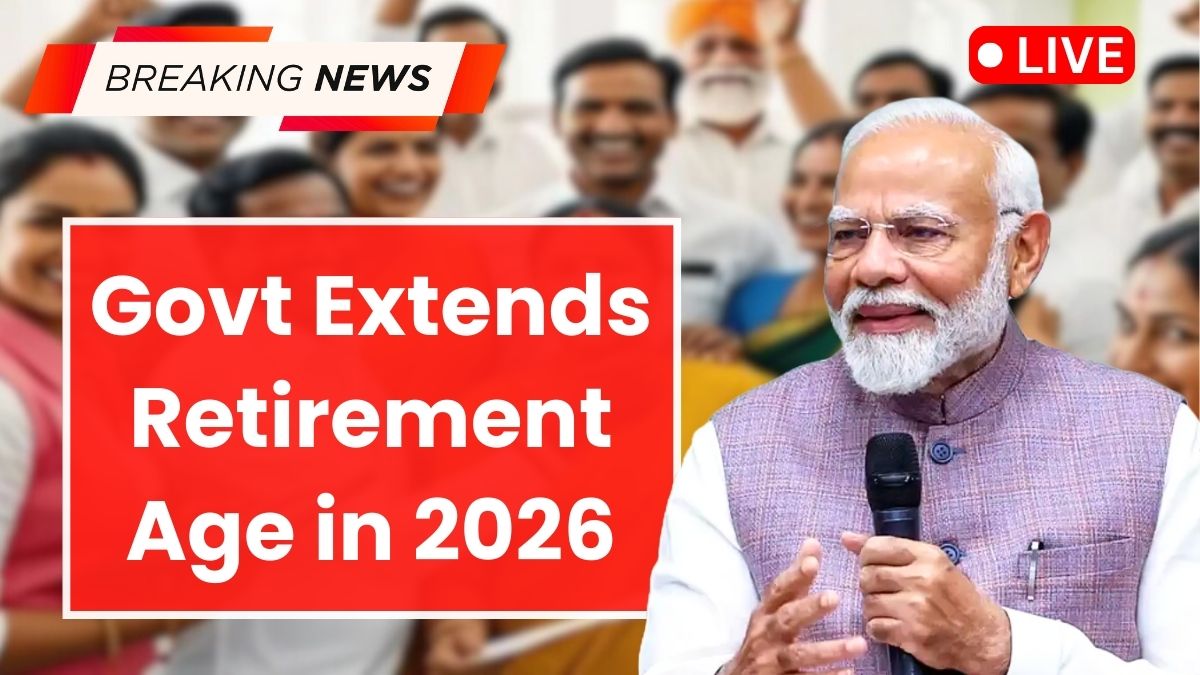
Retirement Age in 2026 : Over the last few months, talk about a possible retirement age extension in 2026 has gained momentum across India. Government employees, staff unions, coaching centres, and job aspirants are all closely following these discussions. For employees nearing retirement, the idea of working longer brings hope of higher pension and financial stability. For younger candidates waiting for government jobs, the same news creates concern about delayed vacancies.
However, much of the information circulating online is incomplete or misunderstood. Retirement age decisions in India are not simple or uniform. Without clear awareness of how such policies are framed and implemented, rumours can easily be mistaken for confirmed decisions.
Why Retirement Age Keeps Coming Back Into Debate
Retirement age has remained a recurring topic in policy discussions for years. One major reason is rising life expectancy. With better healthcare and improved living conditions, many employees remain physically and mentally fit well into their early sixties. Government departments often argue that experienced officers retiring at a fixed age results in loss of institutional knowledge, especially in technical, academic, and administrative roles.

At the same time, India has a very young population. Every year, millions of educated youth enter the job market hoping for stable government employment. Increasing retirement age directly affects vacancy creation, promotions, and recruitment cycles. This constant tension between retaining experience and generating employment ensures that retirement age debates never completely fade away.
Who Actually Decides Retirement Age in India
One of the biggest reasons behind confusion is the belief that retirement age is decided uniformly across the country. In reality, this is not the case. The central government decides retirement rules only for central government employees. State governments have complete authority to decide retirement age for their own staff, which is why retirement age differs from state to state.
Additionally, different sectors follow different service rules. Defence personnel, judges, university professors, doctors, and public sector undertaking employees all operate under separate frameworks. A decision affecting one group does not automatically apply to others. This fragmented structure makes it easy for selective decisions to be misinterpreted as nationwide policy changes.

What Is Officially Known About Retirement Age in 2026
As of now, there is no official notification confirming an overall retirement age increase in 2026 for all central government employees. No circular or announcement has been issued by the Department of Personnel and Training or any other central authority to support such claims.
Most rumours originate from specific cases where service extensions were granted to address staff shortages. In recent years, doctors, university teachers, and technical experts in certain fields were allowed to continue beyond the usual retirement age. These were exception-based decisions, not a blanket policy change. Presenting these cases as proof of a nationwide retirement age extension is misleading.
Who Would Benefit If Retirement Age Is Increased
If the retirement age were increased in the future, employees close to retirement would benefit the most. Even an additional one or two years of service can significantly improve pension calculations, gratuity payouts, and overall retirement savings. For families relying on a single government income, this extra time can provide much-needed financial security.

Senior officers may also benefit professionally, as extended service allows them to complete long-term projects and retain leadership roles. Departments dealing with skill shortages may gain from continuity and reduced training costs.
Who Might Face Disadvantages
On the other side, younger employees and job aspirants may face setbacks. Delayed retirements slow down promotions, affecting morale at lower and mid-level positions. Recruitment cycles may also be postponed, reducing opportunities for fresh candidates.
Economists often point out that extending retirement age increases salary expenditure and pension liabilities. At a time when the government is managing fiscal pressures, any such decision must carefully balance costs with benefits.

Factors the Government Considers Before Any Change
Retirement age decisions are influenced by multiple factors, not just employee demand. The government evaluates long-term pension obligations, healthcare costs for ageing employees, administrative efficiency, and workforce productivity. While experienced staff reduce training expenses, an older workforce may also require higher medical and welfare spending.
Political and social considerations are equally important. Any move perceived as limiting employment opportunities can trigger public backlash, especially during periods of economic uncertainty. This is why analysts believe that broad retirement age increases are unlikely in the near future.
What the Future Is Likely to Look Like
Policy experts expect the government to continue with a selective and cautious approach. Instead of a universal retirement age increase in 2026, targeted extensions may be granted in sectors facing acute skill shortages. This allows flexibility without disrupting recruitment pipelines or creating nationwide opposition.

For now, the retirement age remains unchanged unless officially notified. Employees and aspirants are strongly advised to rely only on government orders and gazette notifications rather than social media claims or unofficial reports.
The discussion around retirement age in 2026 reflects genuine concerns from both employees and job seekers. However, no confirmed nationwide change has been announced. Until official communication is released, the existing retirement framework remains in place. Staying informed through authentic sources is the best way to avoid unnecessary stress and confusion.
Disclaimer

The information provided here regarding retirement age in 2026 is for general awareness only. No official notification or government circular has confirmed any nationwide increase in retirement age for central or state government employees. Any references to extensions in specific sectors are exception-based and not indicative of a policy change. Readers are advised to rely solely on official government orders, gazette notifications, or Department of Personnel and Training announcements, and not on social media or unverified sources.